SiliconVerse
Building editorial infrastructure for the publication covering Africa's next wave of tech

Jefferson Nnaji on
B2B
Internal Tools
Overview
SiliconVerse is a technology media company covering startups, business, and entrepreneurship across Africa. My work there spanned two products — the Silicon Magazine Admin Dashboard and the main Silicon Dashboard platform — each serving a different user with a different set of needs.
On the magazine side, I designed the admin dashboard from scratch across 18 screens, collaborated on the public-facing Silicon Magazine main page, and designed the reader-facing magazine pages where published content lives. On the platform side, I contributed to the main Silicon Dashboard as part of a broader design team, owning the new user onboarding, login and registration flows, the About screen, Privacy Policy screen, and additional supporting screens.
Role: Product Designer Scope: Greenfield Admin System, Magazine Pages, User Flows, Cross-Product Collaboration Platform: Web (B2B and Consumer)
Silicon Magazine Admin Dashboard — Designing From Zero
There was no previous version. I was handed a brief and a blank canvas, which sounds like freedom but is genuinely the harder assignment. When you redesign something, the existing product tells you what is broken. When you design from nothing, you have to construct the problem yourself before you can solve it.
Silicon Magazine covers high-potential African startups and tracks trends across tech, business, and entrepreneurship. The admin dashboard was built for the editorial team — the people responsible for deciding what gets published, when it goes out, and how it performs once it does. At 18 screens, the scope covered content management, the full editorial pipeline, and analytics views showing views, interactions, and audience behavior.
The central challenge in any editorial tool is sequence. An article does not move from idea to published in a single step. It passes through writing, editing, review, approval, and scheduling — multiple stages, multiple people, multiple decision points. A dashboard that cannot represent that sequence clearly does not just create frustration. It creates errors, missed deadlines, and content that reaches readers before it is ready.
I organized the information architecture around task state rather than content type. The question the interface had to answer at a glance was not "what articles exist?" but "what needs attention right now?" Surfacing urgency — what is overdue, what is in review, what is cleared to publish — became the primary hierarchy decision and shaped every screen that followed.
The analytics layer required a different kind of thinking. Editorial teams are not data teams. A content editor reading performance numbers needs to understand what those numbers mean for their next editorial call — is this type of story resonating, should we commission more of it, is this format losing readers halfway through? I designed those views around the decision the editor was trying to make, not around the data itself. The information had to point somewhere useful, not just exist.
Across 18 screens, the goal stayed the same throughout: dense enough to manage a real editorial operation, navigable enough that anyone on the team could orient themselves without needing to be shown around.
Silicon Magazine Pages — The Reader-Facing Product
Alongside the admin work, I designed the reader-facing magazine pages — the surfaces where published content actually lives. These are the screens a reader lands on after clicking through from a headline: the article listing pages that show what has been published, and the individual content views where the reading happens.
The design challenge here is different from the admin side in almost every way. The admin dashboard is a tool for professionals doing a job. The magazine pages are an experience for a reader making a choice — whether to stay, whether to read, whether to come back. Every layout decision had to earn attention rather than demand it.
I also collaborated with the broader team on the Silicon Magazine main page. Working within a shared design direction while contributing meaningfully to it required understanding the system logic before extending it — a different discipline than solo work, but an important one.
Silicon Dashboard — Owned Contribution
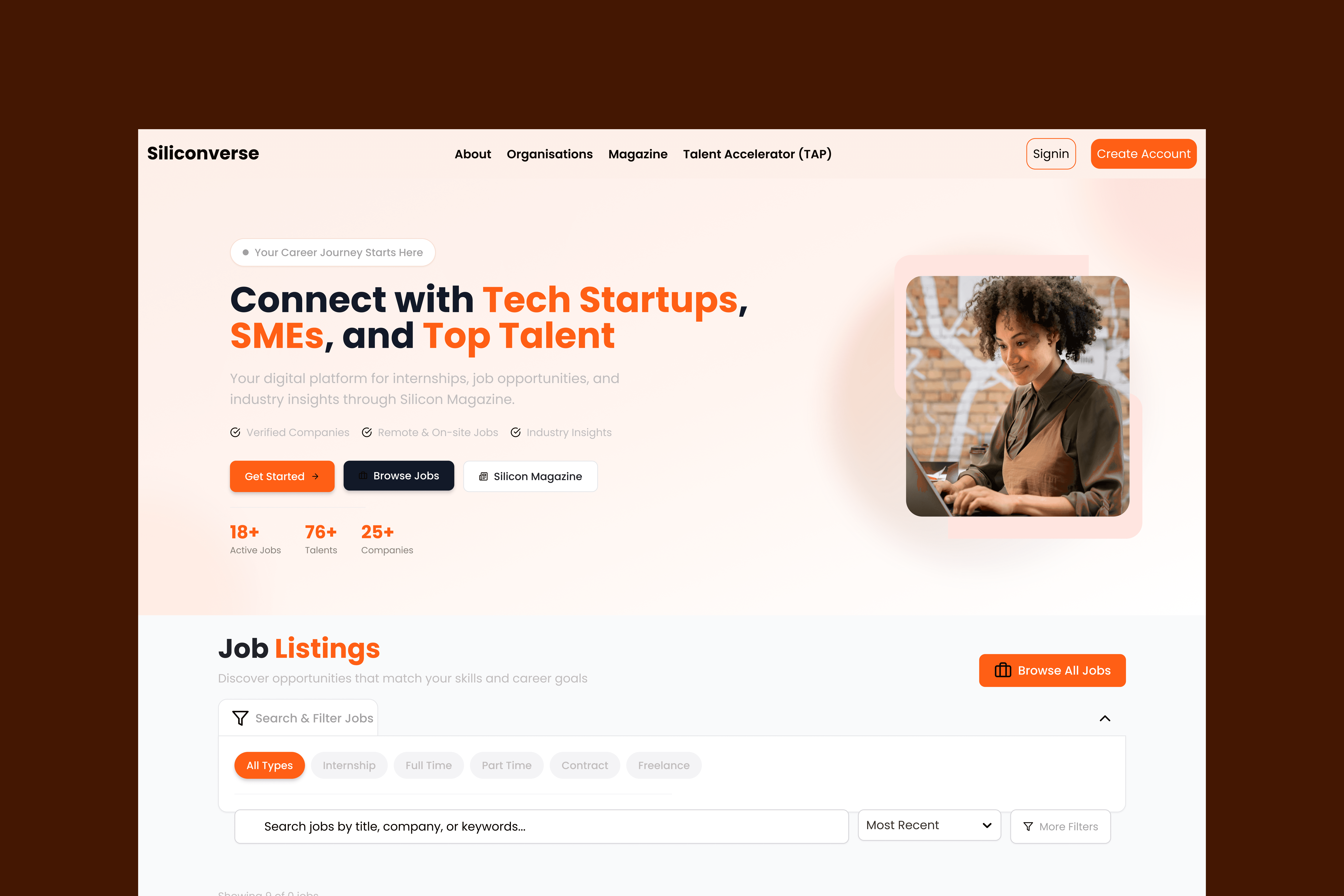
The main Silicon Dashboard is a two-sided platform where companies post opportunities and talents come to find them. Getting either side into the product starts at the same place — registration — and that entry experience is where I focused.
I owned the new user onboarding flow, designing the path a first-time user takes from arriving on the platform to becoming either a registered company or a registered talent. Two-sided platforms have a registration challenge that single-sided products do not: the first decision a new user faces has to orient them correctly before asking anything of them. Choosing the wrong path wastes their time and breaks trust at the worst possible moment. I designed that decision point and the flows that branched from it, including the complete login and registration experience.
Beyond core onboarding, I designed the About screen and Privacy Policy screen. These are surfaces most designers treat as afterthoughts, but on a platform where both companies and job seekers are sharing sensitive professional information, they carry real credibility weight. A user deciding whether to trust a platform with their career or their hiring process reads those pages carefully. They needed to feel considered, not templated.
My contribution here was not the full product — I worked within a larger team on specific flows I owned end to end. Focused ownership of the entry experience on a two-sided platform is a consequential design problem. First impressions on a marketplace directly determine whether the platform can build supply and demand at the same time. That is what I was solving for.
What I Learned
Working across two products at SiliconVerse — one editorial tool, one talent marketplace — inside the same engagement taught me something about the range this work demands. The admin dashboard required thinking like an operator: dense information, professional users, zero tolerance for ambiguity in the workflow. The magazine pages required thinking like a reader: emotional entry points, scannable hierarchy, layouts that make staying feel effortless. The platform onboarding required thinking like someone arriving cold, deciding in seconds whether the product is worth their time.
The discipline connecting all three was the same. Understand who is sitting in front of the screen, what they need to know in the first five seconds, and build everything else in service of that answer. Complexity is not a problem to eliminate in products like these — the work is genuinely complex and the users know it. The job is to organize that complexity so it stops feeling like weight.
Due to an NDA, internal screens from both the Silicon Magazine Admin Dashboard and the Silicon Magazine pages cannot be shown at this time, as both products are still in active development. The illustrative mockups presented here are representative of the design language and approach, and do not reproduce proprietary product screens.